

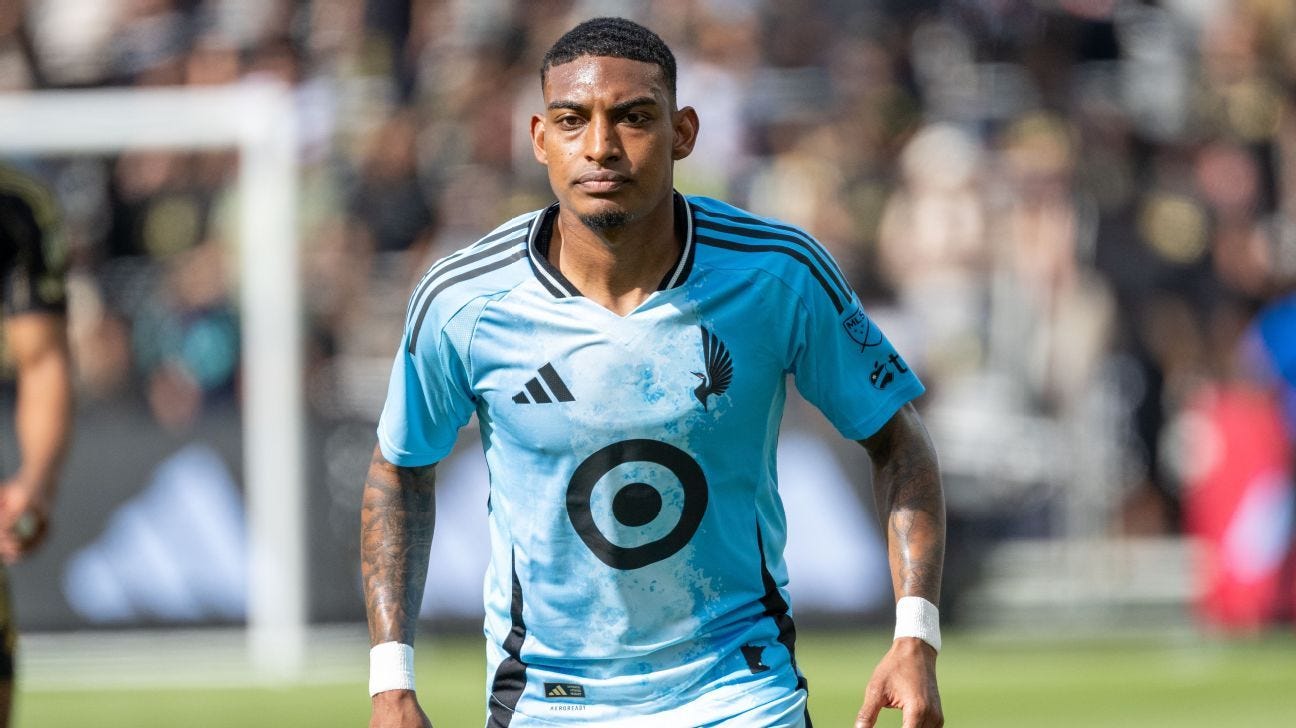
When the cash for player system was introduced by MLS, the use cases seemed to be limited. With the transfer fees being applied to the player’s budget charge, it seemed to only make sense for future U22s and DPs to be acquired. And to that point, up to this off-season, no trade had been done for a player who wasn’t a U22 or a DP.
However, we’ve seen two deals that have been fundamentally different. Joseph Rosales was shipped out to Austin FC, and Tomas Chancalay was traded to Minnesota. What makes these deals unique? Well, for one, one of the deals (namely the Chancalay deal) could’ve been done with GAM. The fee was super low, but the Loons elected to go the cashfer route. Why?
Well, let’s dive in.
Joseph Rosales to Austin FC

There are so many layers to this deal. When it was first reported that Rosales was going to be a GAM deal, I immediately thought how much this reinforced the idea that Austin is going 2+4 with the sale of Osman Bukari. Austin does not have a lot of 2026 GAM. They tied up their GAM with two deals: Jayden Nelson ($700K) and Robert Taylor ($250K). There are also a couple of smaller deals where they gained and lost GAM, but the net total traded is around $850K. Here’s a rundown of some calculations to show you what I am estimating the Austin FC number to be:

That estimate has Austin as the lowest team in the league. If Austin elects to go 3+3, they have to be magical with how they’re using their GAM. There are reports of Tadeo Allende being linked with the team, and if he is, my guess is he’d be a DP based on Celta Vigo’s asks and his previous salary. In my opinion, with how rough this GAM setup looks, I’d prefer to see the team go 2+4 and spread the money across its entire roster. We’ve seen teams have plenty of success in the setup, but the Rosales trade makes even more sense when you think about the money they must preserve. They potentially have figured out a way to use zero GAM to improve their roster.
Austin is essentially injecting $1.5M of money into the GAM ecosystem. Along with the money, Rosales signed a new 3.5-year deal. Why is this important? When calculating whether a player is TAM or GAM, it’s dependent on his average budget charge across the guaranteed term of the deal.

With his previous MLSPA amount, Rosales would be over the TAM line, meaning that Austin FC can use TAM to pay off his budget charge. Remember, you can’t use that mechanism unless your budget charge is above the max budget charge ($803,125 in 2026) and below the max TAM line, which is $1M greater than the max budget charge. In fact, if Austin’s average contract for Rosales is greater than $374,554, he should be a TAM player. Again, this is my problem with it; simply combine it with GAM and let it be applied across the entire roster. The fact that Austin has to do this to unlock it is silly to me, but using the cashfer system to facilitate this makes absolute sense.
Austin has no players who are TAM eligible after the departure of Julio Cascante. Why lock up and spend boatloads of allocation money to improve your roster when you can do a cashfer instead? And for MLS, this naturally allows the league to increase spending across its teams without altering the existing structures.
The key caveat for Minnesota is the designation of Rosales. More than likely, Rosales will not be a DP or a U22. If that’s the case, per the MLS Roster Rules and Regulations, Minnesota will be required to convert that $1.5M (or whatever the payment instalment is) into GAM. The Loons have a ton of allocation money and will continue to grow that amount with this move. The question remains if they will spend a bunch of it or continue to keep the powder dry going into the 2026 season.
Overall, the move benefits both sides. Minnesota opens up more room for Anthony Markanic, and Austin avoids using its small amount of GAM to acquire players. Plus, we see more money entered into the system. It’s a win for every party involved.
Tomas Chancalay to Minnesota

When I first saw this deal, I was genuinely confused. The amount spent was so low that it was a bit odd that it wasn’t a deal involving GAM. After all, we just mentioned how Minnesota is sitting on so much allocation money. Why would they do a deal using this mechanism?
The devil is in the details.
Let’s start with Chancalay’s status. We’ve touched upon this on FAM in a previous article, but Chancalay was a full DP in 2025. The reason? His average budget charge was greater than the max TAM line. Remember, his transfer fee was around $3M. He signed a three-year-deal. That means for his full DP calculation, he’s already carrying a $1M budget charge plus whatever his salary is. Here are the calculations for his budget charge. If Chancalay were playing on the Revs in 2026, he would be a full DP.


If this were a GAM deal, he also would have to be a DP on someone’s roster. Remember the Giacomo Vrioni deal last off-season? Montreal acquired him for $50K GAM, but because he was a full DP, he had to either be a full DP on their roster or on New England’s. In the 2025 Roster Profiles, we see Vrioni listed as a full DP for MTL.
Minnesota has all of this GAM, as we mentioned… they probably want Chancalay as a TAM-level player (which you can also buy down with GAM). Having him as a full DP doesn’t match their roster construction model, and again, why not use a GAM deal and make it easier for everyone? In New England’s situation, they want to clear the DP spot for roster building.
The acquiring club must declare the player’s Roster and Budget designation, which will be determined by the player’s compensation set forth in his contract, any other player-related costs, including the cash traded and any Player Percentage received, and any existing payment obligations to a non-MLS third-party under a previous acquisition agreement. (2025 MLS Roster Rules and Regulations)
There’s the kicker. What does this mean? Essentially, whatever of Chancalay’s already paid transfer fee is not included in this. He’s been at the club for two years, so it’s a possibility that the vast majority of his payments are finished. All that’s left is his salary, his new deal, and the other payments that also include the cashfer amount.
Chancalay’s new deal puts him through the 2027-28 season, making his amortised transfer fee $50K, instead of the $1M we previously mentioned. His 2025 salary was around $1M, and depending on whatever is left to be paid, Those numbers alone change the calculation; now, Chancalay is not a full DP. Based on the news releases, we’re seeing that he hasn’t been declared a DP (as it normally would be mentioned), so we’re assuming that the fee left is either zero or very small. His budget charge should be below the max TAM line, making him eligible to be bought down.
The cashfer deal’s fee supercedes the previous transfer amount. MLS has implemented this to help retain talent in the league, and this specific move is another example of it. The Revs, according to my estimates, had the fourth-fewest amount of GAM in the league with the 3+3 model. This allows them to go 2+4, and open up more GAM. Matt Turner can be bought down, and it gives them room to add another DP and unlock the $2M in dGAM. It’s a dump for them to open the slot and help rebuild the team.
For the Loons, they have so much money that, genuinely, they probably could have almost all of the senior roster be TAM players. It’s a low-risk, high-reward play for a team that is looking to continue competing in MLS.
We’re finally seeing the full potential of cashfers across MLS. There’s so much going on in year two of this new mechanism that I’m now even more of a believer. Will it continue into the new CBA? Who knows, but it’s for sure made this league interesting.
Till next time!